Some paintings exist because a king wanted to look powerful. Others because a merchant wanted to look wealthy. Some exist simply because an artist saw a landscape, a face or a bowl of fruit and decided that the world needed another way of looking at it.
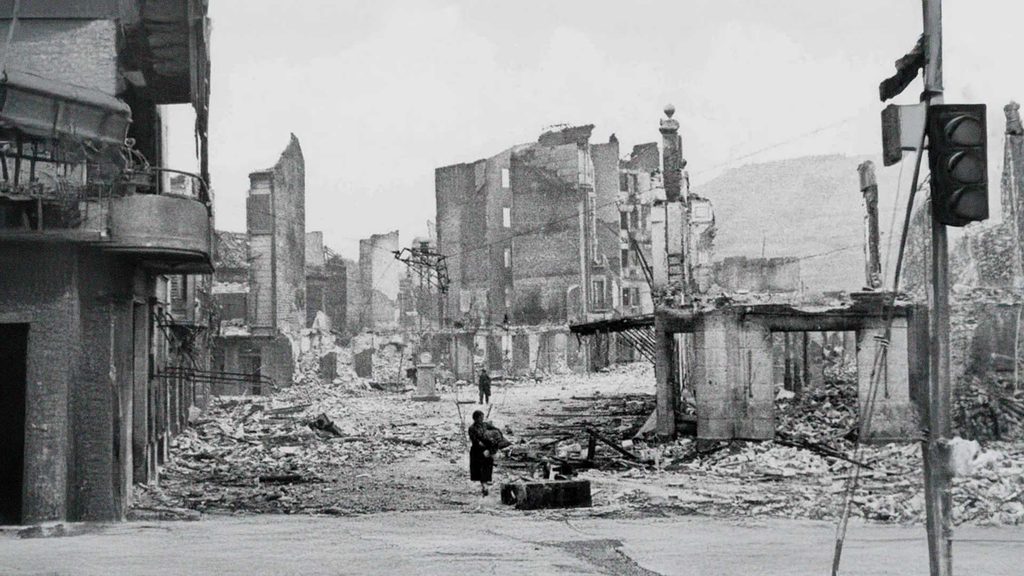
Guernica exists for a very different reason. On 26 April 1937, aircraft from Nazi Germany’s Condor Legion and Fascist Italy’s Aviazione Legionaria attacked the Basque town of Gernika in support of Franco’s Nationalist forces during the Spanish Civil War. The raid lasted for hours, destroyed much of the town and killed an uncertain number of civilians.
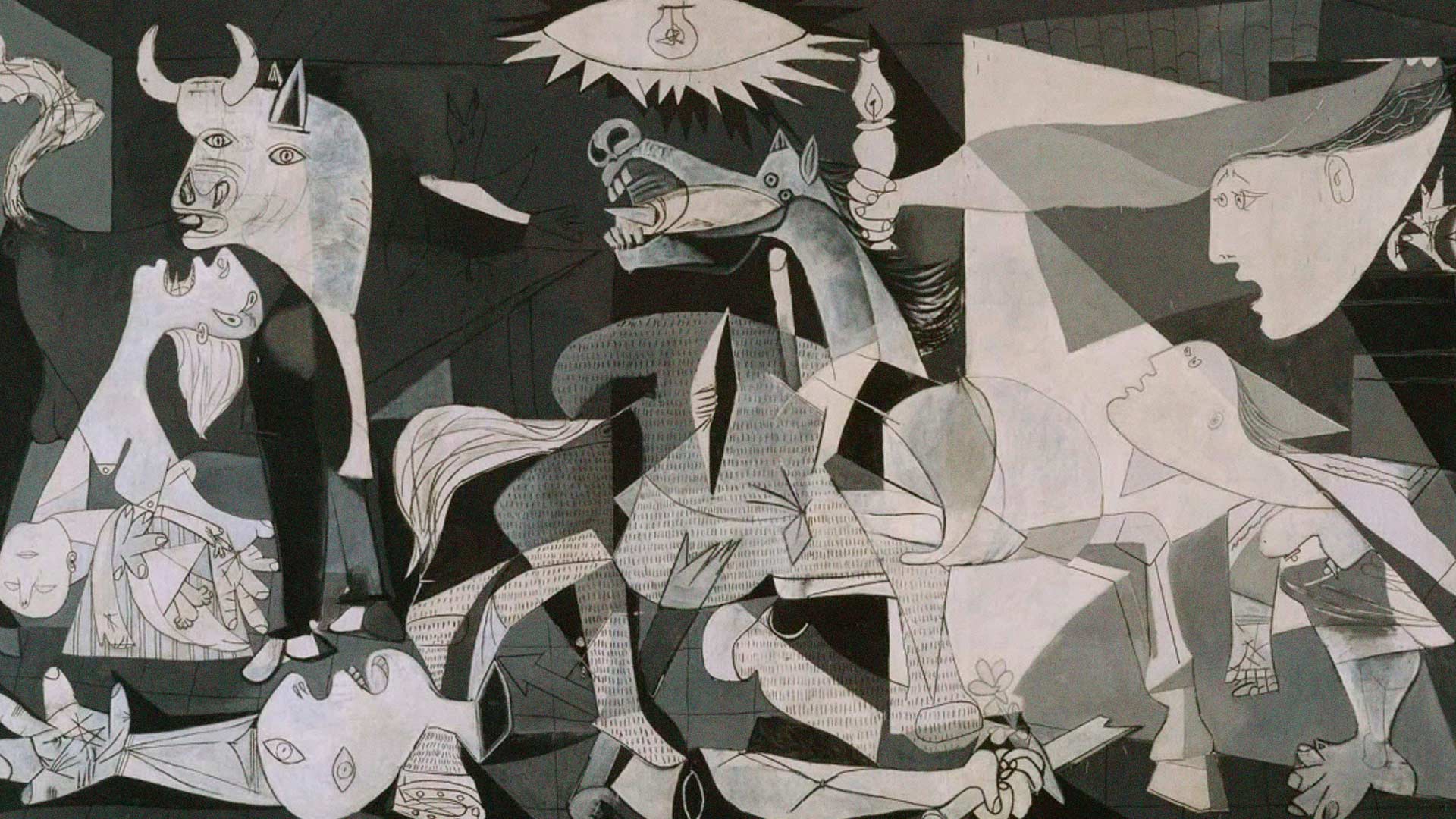
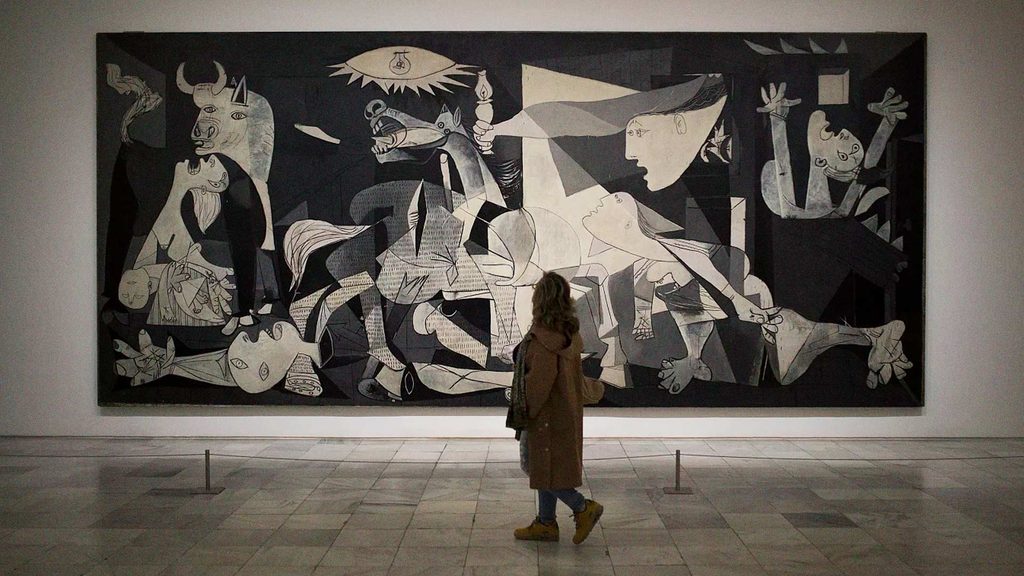
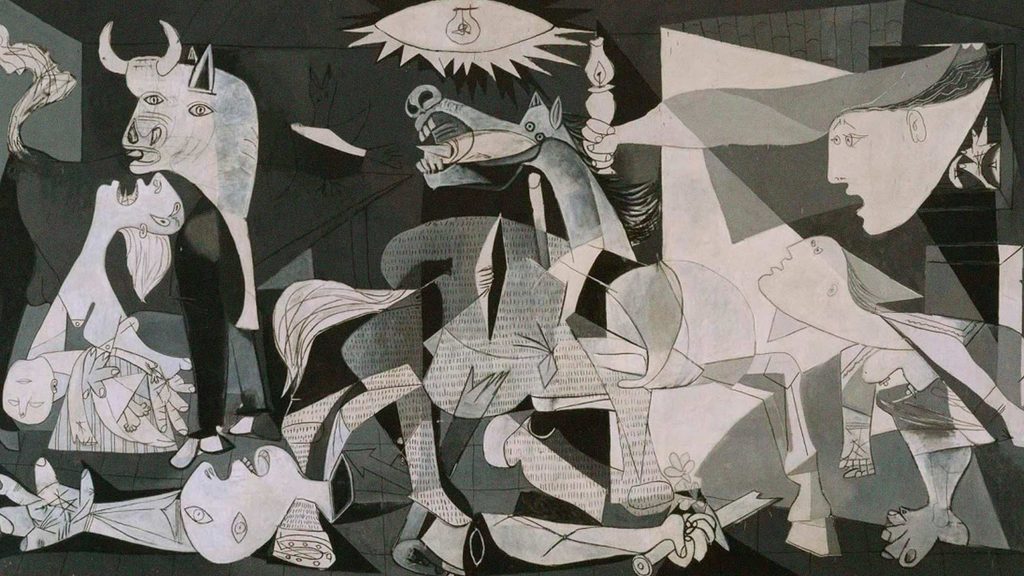
Pablo Picasso’s Guernica has become one of the most recognisable paintings of the twentieth century. We reproduce it in textbooks, print it on posters and analyse its bulls, horses and screaming women in classrooms. Today, it hangs at Madrid’s Museo Reina Sofía, where visitors gather in front of its enormous surface almost as if approaching a secular altar.
Yet there is something uncomfortable about calling Guernica a masterpiece. Usually, a masterpiece makes us grateful that somebody created it. Guernica is different. We can be grateful that Picasso painted it while wishing that he had never needed to.
That may be the first thing we need to understand about Guernica: it is an extraordinary painting born from something that should never have happened.
Before Guernica, there was Gernika
By the spring of 1937, Spain had been at war with itself for almost a year. In July 1936, a military uprising against the democratically elected Second Republic had failed to seize the entire country and instead triggered the Spanish Civil War. Francisco Franco gradually emerged as the leader of the Nationalist forces, while Nazi Germany and Fascist Italy supplied his side with aircraft, weapons, troops and military assistance.
Meanwhile, the Republican government had commissioned Picasso to produce a large mural for the Spanish Pavilion at the 1937 International Exposition in Paris. Picasso had lived in France for decades, but the Republic had also appointed him director of the Prado Museum, largely as a symbolic gesture. He opposed Franco and supported the Republican cause.
There was only one problem: Picasso did not know what to paint. His first ideas had little to do with war. He worked on scenes involving the artist and his model, a recurring subject in his work. Then came the news from the Basque Country.
The Day That Changed Everything
On the afternoon of 26 April, German and Italian aircraft attacked Gernika. The operation formed part of the Nationalist campaign in northern Spain, but its consequences reached far beyond the immediate military context. Journalists reported the devastation abroad, while Francoist propaganda initially denied responsibility and claimed that retreating Republicans had destroyed the town themselves.
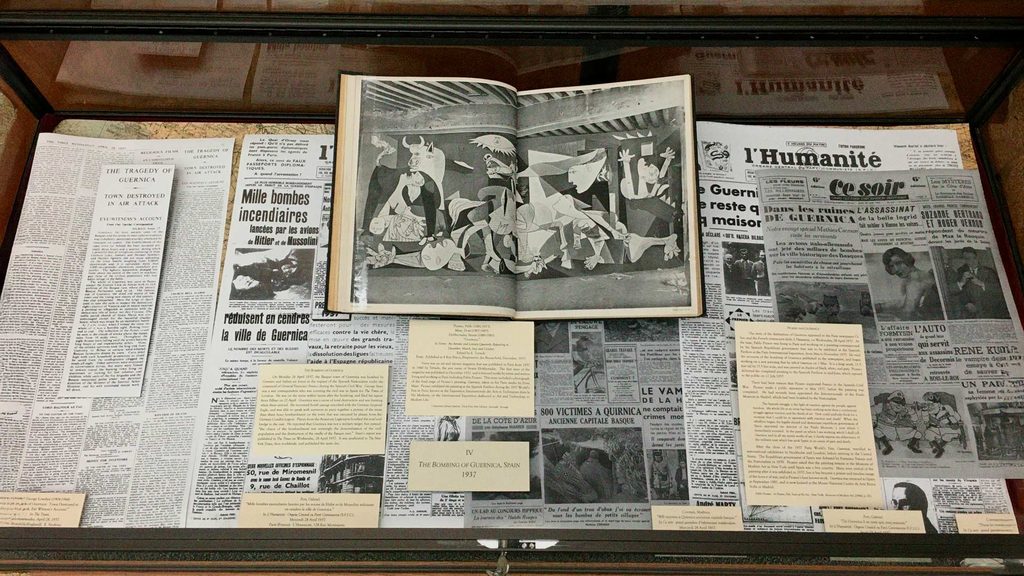
Picasso read about the attack in Paris. Soon afterwards, Guernica began to take shape. The Museo Reina Sofía’s research project on the painting documents the commission, the bombing and Picasso’s working process in considerable detail.
A Masterpiece in Record Time
Over roughly five weeks, he produced sketches, altered figures and repeatedly reorganised the composition. Photographer Dora Maar documented several stages of the process, giving us the rare opportunity to watch one of the twentieth century’s most famous paintings evolve almost day by day.
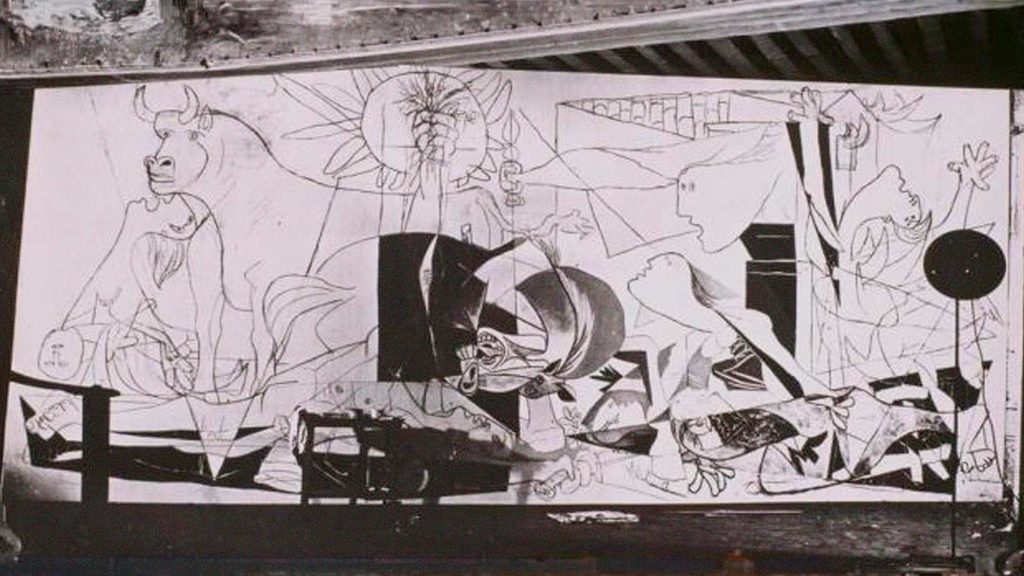
The finished canvas was enormous: around 3.5 metres high and 7.8 metres wide. More precisely, the Museo Reina Sofía records its dimensions as 349.3 by 776.6 centimetres. Yet Picasso made a curious decision. He painted Gernika without actually showing Gernika.
There are no German bombers in the sky. No Italian aircraft. No Francoist soldiers. There is not even a conventional battlefield. If we removed the title and the historical context, nothing in the painting would tell us precisely where this catastrophe took place.
Paradoxically, that is one of the reasons the painting became universal.
Picasso did not paint the bombing. He painted what bombing does
Look at Guernica from a distance and the first thing you notice is confusion. Bodies overlap. Heads twist backwards. Arms stretch in impossible directions. A horse convulses at the centre. A woman holds her dead child. A fallen soldier lies dismembered across the floor. On the right, another figure seems trapped by fire. This confusion is not a failure of composition. It is the subject of the composition.
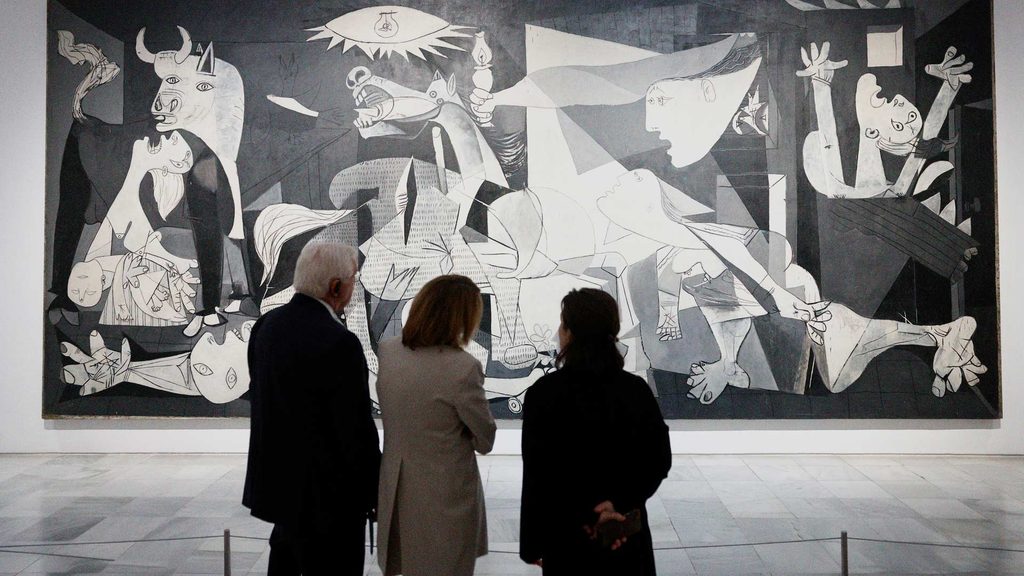
Traditional European history painting often transformed catastrophe into order. Artists organised armies, revolutions and executions so that viewers could understand them. Generals occupied one area, victims another, heroes stood at the centre and events seemed to move towards some kind of conclusion. Even death received choreography.
Picasso offers no such comfort. Although Guernica still borrows elements from the grand tradition of history painting, its world has lost the stability that tradition once promised. The figures share the same compressed space, but they do not inhabit a rational world.
Cubism: The Essence of Guernica
For decades, Picasso and Georges Braque had broken objects into multiple viewpoints, showing a face from the front and side at once or fragmenting a guitar into geometric planes.
In Guernica, fragmentation suddenly acquires a brutal logic. The bodies look broken because their world has broken with them. Why should a civilisation shattered by modern warfare remain visually intact?
Why is Guernica black and white?
One of the most striking things about Guernica is what it lacks: colour. Picasso restricts himself almost entirely to black, white and shades of grey.
The choice connects the painting to the photographs and newspaper reports through which the bombing reached international audiences. The monochrome palette gives Guernica something of the visual character of the mass media of its time. It feels less like a distant myth and more like evidence arriving from yesterday’s newspaper.
However, removing colour also changes our relationship with the painting. Colour can seduce. A beautiful red can make blood aesthetically compelling; a dramatic orange can turn flames into spectacle. Picasso largely refuses us that pleasure.
A cold, harsh and almost drained of life painting
That restraint also connects the painting to a much older artistic tradition. Painters had used grisaille, painting predominantly in shades of grey, for centuries. Picasso therefore combines something very modern, the language of newspapers and photography, with something deeply historical.
This mixture appears throughout Guernica. The painting looks radically modern, yet ghosts from the history of Western art move inside it.
A mother who has existed for centuries
On the left, a woman holds the lifeless body of her child and throws her head backwards in grief. Her mouth becomes almost a weapon: a sharp, open form pointing towards the sky.
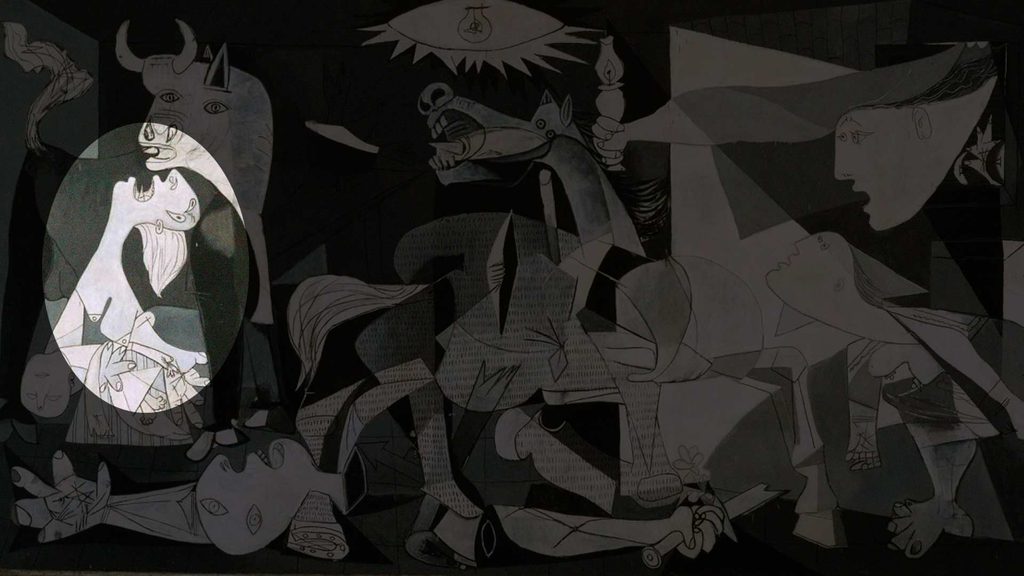
Christian art repeatedly depicted the Virgin Mary mourning the dead Christ, particularly through images of the Pietà. Picasso transforms that familiar structure into something more brutal. Here there is no sacred body, no promise of resurrection and no religious explanation capable of making the suffering meaningful.
There is simply a mother and a dead child. And that difference matters. Traditional religious art could place suffering inside a larger story. Christ dies, but Christians believe he will rise again. Martyrs suffer, but salvation gives their pain a purpose. Guernica offers no such reassurance. Its suffering does not lead anywhere.
The horse and the bull: what do they mean?
Two animals dominate the painting. On the left stands a bull. At the centre, a wounded horse twists in agony, its mouth open and its body pierced. Naturally, generations of viewers have tried to decode them.
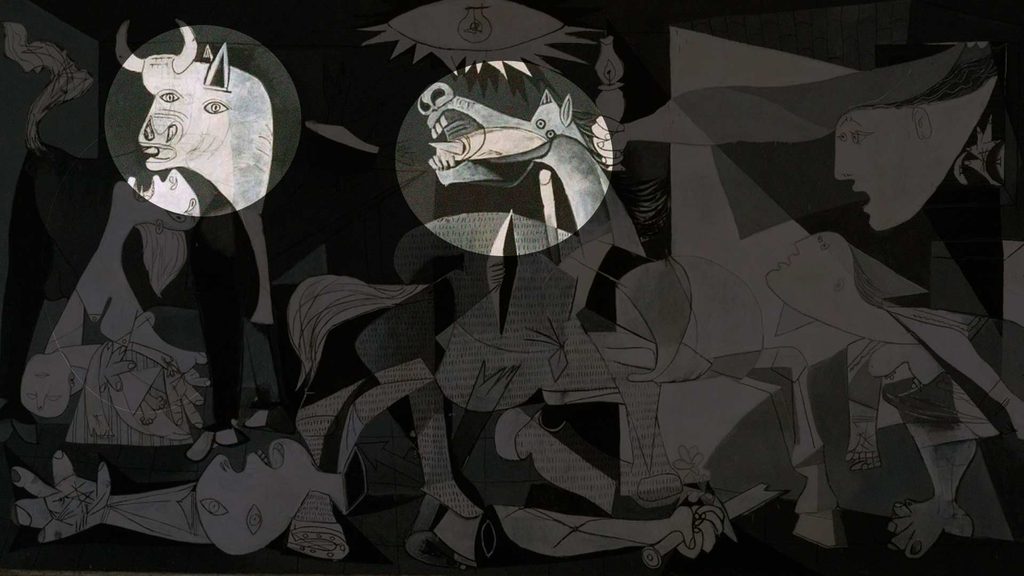
Perhaps the bull represents Franco. Or fascism. Or Spain itself. Some interpretations connect it to Picasso, who had used bulls, bullfighting and the Minotaur repeatedly in his earlier work.
The horse has generated just as many possibilities. It may represent the Spanish people, the Republic, innocent civilians or simply suffering itself.
The problem begins when we treat Guernica like a crossword puzzle. Bull equals X. Horse equals Y. Lamp equals Z. Solve enough clues and we assume that the painting will finally reveal its secret. But art rarely works like that.
Picasso himself resisted fixed interpretations of every individual symbol, and debates over their meaning began almost as soon as the painting appeared. The uncertainty forms part of the work’s power. Guernica gives us recognisable images without reducing them to a single definition.
After all, a screaming horse does not need to represent the Spanish Republic before we understand that it is in pain. A mother does not need to symbolise a nation before we recognise her grief.
Perhaps the symbols survived precisely because Picasso left enough space inside them for later generations to enter.
The strange light at the centre of Guernica
Above the horse appears one of the painting’s strangest objects: an electric light bulb surrounded by a shape that resembles an eye. Nearby, a woman stretches into the scene holding an oil lamp. Two forms of light occupy almost the same space: one ancient and one modern.
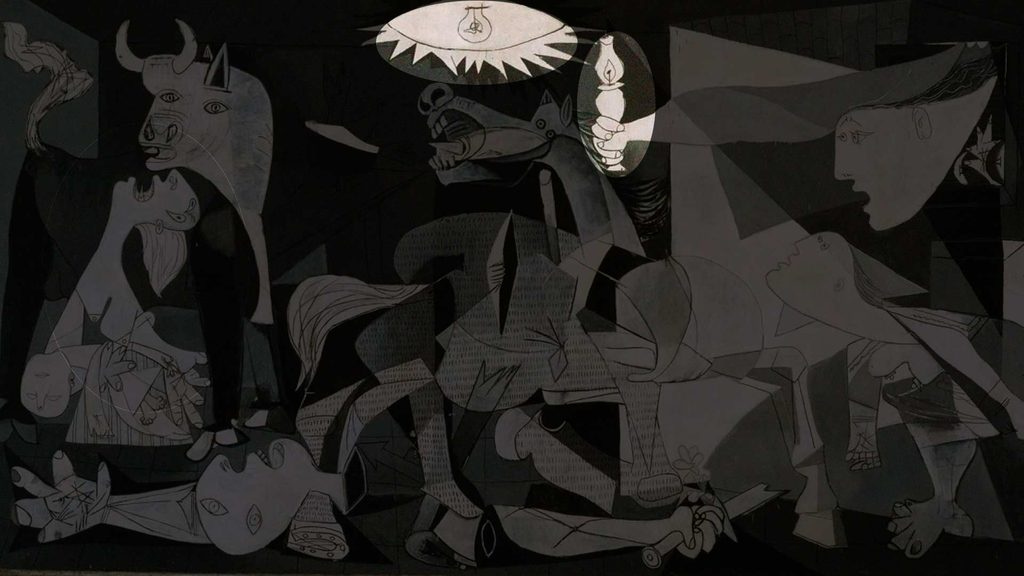
That contrast opens several possible interpretations. The electric bulb may suggest technology, surveillance or the machinery of the modern world. Some critics have also noticed the visual and verbal association between the Spanish words bombilla, meaning light bulb, and bomba, meaning bomb, although we should treat that connection as interpretation rather than established authorial intention.
The oil lamp, meanwhile, seems more human. A hand carries it into the darkness as though someone were trying to understand what has happened. Yet neither light saves anyone. Both merely illuminate the disaster.
There is a disturbing idea hidden here. Human beings often confuse technological progress with moral progress. We learn to build better engines, faster aircraft, stronger materials and more powerful machines, and then congratulate ourselves for becoming more advanced.
But intelligence and wisdom are not the same thing. By 1937, humanity had learnt to fly. It had not necessarily learnt what to do once it reached the sky. The same scientific progress that allowed people to cross continents also allowed bombers to reach civilians more efficiently.
Guernica sits inside that contradiction.
Why Guernica should never have existed
Guernica should never have existed. Not because Picasso should not have painted it, but because the event that made the painting necessary should never have happened.
That creates one of art history’s darkest paradoxes. Human suffering has given us extraordinary works of art. War gave us Goya’s The Third of May 1808 and his Disasters of War, along with countless other images of violence and political oppression.
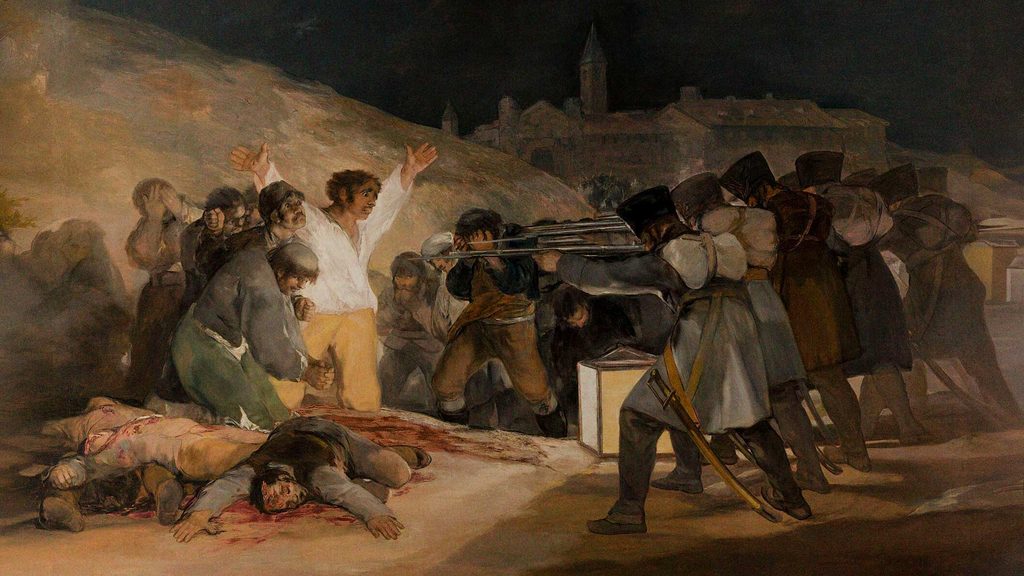
Human beings possess an extraordinary ability to turn suffering into images, stories, poems and music. There is something deeply moving about that impulse. When reality becomes unbearable, we try to give it form.
However, we should never confuse the value of the artwork with the value of the event that produced it.
Beauty can emerge from horror, but beauty does not redeem horror. No masterpiece compensates for a dead child. A great novel doesn’t makes persecution worthwhile. And, of course, no symphony balances the moral account of a massacre.
Art cannot undo what happened. What it can do is prevent what happened from becoming entirely invisible. Perhaps that is one of its oldest functions. Power often wants history to move on. Victims usually need history to remember.
When Guernica travelled to Africa
One of the clearest signs that Picasso had created more than an image of a single Spanish event appeared thirty years later and thousands of kilometres away.
In 1967, South African artist Dumile Feni created African Guernica, a monumental charcoal and pencil drawing produced under apartheid.
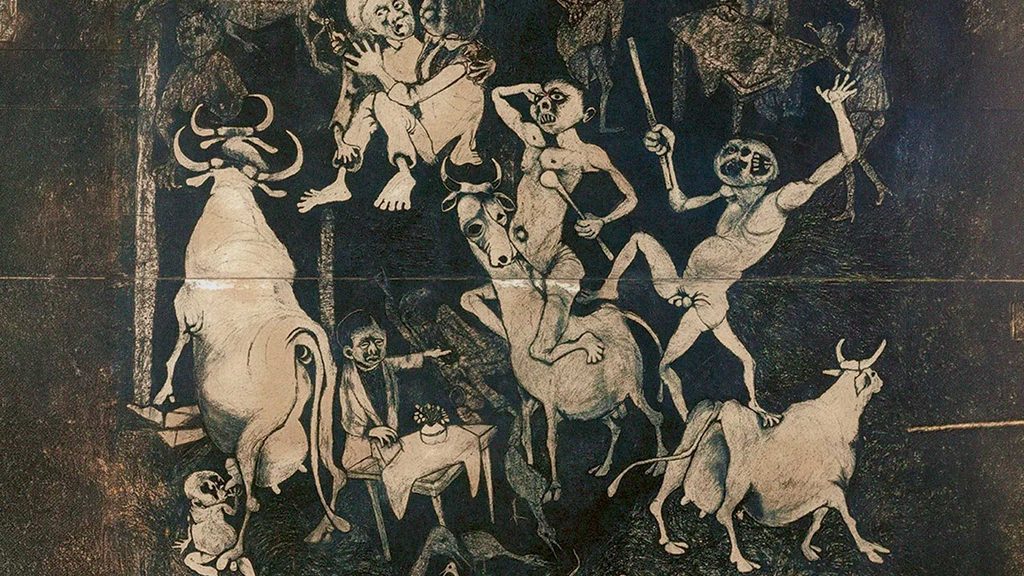
Feni borrowed both the name and parts of Picasso’s visual vocabulary: distorted figures, compressed space, monochrome tones, animals mixed with human bodies and a sense that violence has destroyed the normal organisation of the world. Yet his subject belonged to another continent and another political reality: the institutionalised racial oppression and state violence of apartheid South Africa.
Is history a cycle?
The connection becomes particularly fascinating because influence does not move in only one direction. European modernists, including Picasso, had looked intensely at African sculpture in the early twentieth century, although they often did so through a colonial system that removed African objects from their original cultures and displayed them as supposedly anonymous or “primitive” artefacts.
Then, decades later, an African artist could take a visual language associated with Picasso and use it to describe African suffering.
Art history rarely travels in straight lines. Images migrate. Cultures borrow from one another, willingly or otherwise. Symbols leave one country, change meaning and eventually return wearing different clothes.
In 2026, the Museo Reina Sofía made that dialogue literal by displaying Feni’s African Guernica opposite Picasso’s painting as part of the programme History Doesn’t Repeat Itself, but It Does Rhyme, which explored how later artists have responded to Guernica across different historical and political contexts. The exhibition was scheduled to remain on view until 22 September 2026.
By then, Guernica no longer belonged only to Picasso or even only to Spain. It had become a visual language for describing what happens when political power crushes human bodies.
The strange victory of Guernica
Bombing tries to achieve something very physical. It destroys buildings, infrastructure and people. But it can also attempt something less visible: erasure. A destroyed place can disappear from the world, and its inhabitants can eventually disappear from memory. The attack on Gernika failed in that second objective spectacularly.
The town suffered enormous destruction, but its name became known across the world. Picasso took the name of a relatively small Basque town and attached it to a canvas that would eventually become one of the most famous political artworks ever made. There is a bitter irony in this.
The military forces that attacked Gernika possessed aircraft, explosives and the support of two European dictatorships. The civilians below possessed almost none of that power. And yet, nearly ninety years later, millions of people encounter the event primarily through an image created in response to their suffering.
Weapons usually win the immediate argument. Memory can win a much longer one.
How should future generations look at Guernica?
One day, the Spanish Civil War will feel as remote to future generations as the Napoleonic Wars feel to many people today.
Eventually, names that once produced fear, loyalty or hatred become paragraphs in textbooks. Political parties disappear. Borders move. Eyewitnesses die. History slowly turns lived experience into information. This is precisely when Guernica may become even more important.
Historical facts can tell future generations that Nazi German and Fascist Italian aircraft attacked Gernika on 26 April 1937 in support of Franco’s forces. Documents can explain the military campaign, the political alliances and the disputed casualty figures. Historians can reconstruct what happened with increasing precision.
But facts have limits. They can tell us that people were terrified without making us feel what terror does to a human face. Art operates in that gap.
Future generations should therefore resist treating Guernica merely as “a famous Picasso“. That would be the easiest way to neutralise it. Nor should they approach it only as a puzzle, memorising that the horse may mean this and the bull may mean that before moving on to the next work in the museum.
They should ask a more uncomfortable question: why do human beings keep creating new Guernicas?
The contemporary relevance of Guernica
Picasso responded to one town in 1937, but the painting survived because history continued to produce other towns, other bombings and other civilians trapped between political ideas far larger than themselves.
Different countries give their wars different names. They change the uniforms, flags, languages and justifications. The mothers still hold their children in much the same way.
That is why Guernica remains contemporary. Not because Picasso somehow painted the future, but because the future has repeatedly failed to leave Guernica behind.
Maybe one day people will stand before Guernica and find it difficult to understand. Not because they have forgotten history, but because the particular kind of horror it depicts has become genuinely foreign to them.
Perhaps a future child will look at the screaming horse, the burning house and the mother holding her dead son and ask why human beings ever did such things to one another.
If that day comes, Guernica will finally have become what it should have been from the beginning: a painting about a world that no longer exists.